
Cassava Could Lose Up to 86% of Its Vitamin A During Garri Processing
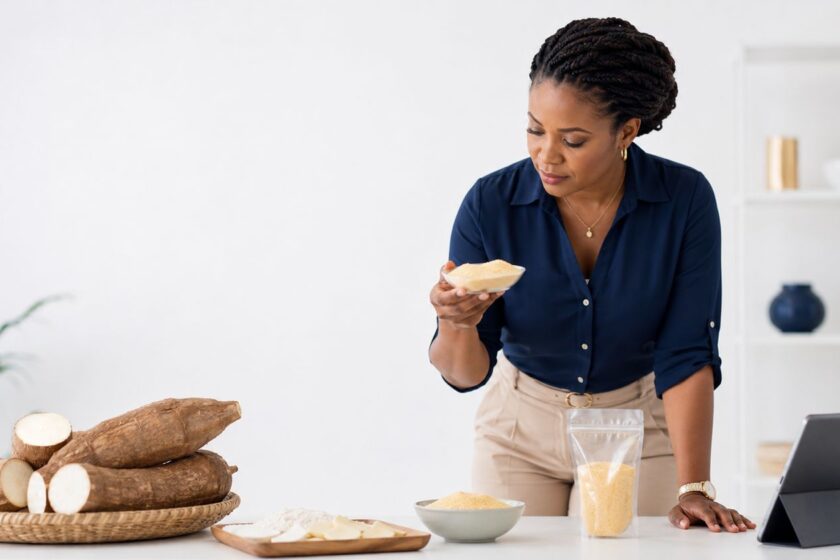
If you say “my product is nutritious because it was made from soya, millet, and groundnut,” you are right. You are also not fully right.
A food product does not become valuable just because the raw ingredient is nutritious. Its real value comes from three things together: the ingredient chosen, how it's processed, and how much nutrition is still standing by the time it reaches the consumer. That third part is where agrifood MSMEs quietly lose value. They start with good ingredients, use familiar processing methods, and make strong nutrition claims, without ever checking whether the final product still carries what's written on the label.
Good Ingredients are Only the Starting Point
Soya strengthens protein. Millet and sorghum improve dietary diversity. Groundnut and sesame add energy, fats, and minerals. Biofortified cassava and orange-fleshed sweet potato support provitamin A intake. Baobab contributes vitamin C. But here's a question: after sorting, washing, peeling, fermenting, drying, roasting, milling, packaging, and storage, what amount of nutrient actually remains?
That's called nutrient retention, the proportion of a nutrient that survives processing, cooking, and storage. The USDA Table of Nutrient Retention Factors is the reference data most commonly used to estimate this. Nutrients don't behave the same way under pressure. Protein is generally more stable than vitamin C. Minerals hold up better than most vitamins. Heat, water, oxygen, light, and storage time each take their own toll, in different amounts, on different nutrients.
When a business says “high protein,” “rich in vitamin A,” or “fortified,” that claim has to survive the processing line. Not emotionally. Not visually. Scientifically. An ingredient gives a product nutrition potential. Potential is not delivered value.
Processing Can Build Value, or Quietly Strip it Away
Processing is not the enemy of nutrition and shouldn't be treated that way. It improves food safety, shelf life, digestibility, and market access. It cuts post-harvest loss and keeps seasonal foods available longer. But poorly chosen or poorly controlled methods do reduce nutrients, and FAO's own review of processing effects on roots, tubers, and their derived products, including garri, confirms this loss happens across proteins, vitamins, and minerals depending on the food and the method, with over a third of protein lost in garri production alone.
Garri made from vitamin A biofortified cassava shows this clearly. Nobody eats raw cassava root. People eat garri as eba and fufu, and by the time cassava becomes either of those, it has gone through grating, fermentation, pressing, and roasting. A Nigerian study on biofortified cassava products found beta-carotene retention ranged from 14.4 percent to 29.3 percent for garri, and 10 percent to 21.7 percent for eba. At the low end, that means up to 86 percent of the original vitamin A content is lost before the product reaches the plate.
That means two businesses can start with the same vitamin A cassava and end up selling products with sharply different nutrition value, purely because of processing choices. One is selling delivered nutrition. The other is selling a story the product cannot back up.
Orange-fleshed sweet potato tells the same story. A boiled root, a dried flour, a biscuit, a complementary food, none of these deliver the same nutrient profile, because each has gone through a different process. The real business question isn't “what ingredient did we use.” It's “what did our process do to that ingredient.”
The business that improves retention, documents the method, and tests the final product walks away with stronger positioning and stronger buyer trust.
Evidence Is What Turns Nutrition into Market Trust
Nutrient retention shouldn't sit only in a lab report. It should shape product development, costing, labelling, and investor readiness.
A cereal-legume complementary food needs more than a good recipe. It needs proof that anti-nutritional factors, natural compounds that block nutrient absorption, have actually been reduced through deliberate soaking, fermentation, or roasting. A baobab drink loses vitamin C steadily through heat, light, and storage, so any vitamin C claim needs to account for that loss. Roasted nut producers face rancidity, aflatoxin risk, and shelf life questions that decide whether the pack's nutrition story still holds two months after production. And moringa cannot simply be sprinkled into a recipe and the product called nutritious. Dosage, taste, safety, and whether the claim is even legally permissible all have to be worked out first.
There's a regulatory layer too, and it isn't optional. Codex guidelines on nutrition claims define a nutrition claim as any statement suggesting particular nutritional properties, and require a nutrient declaration to back it up. In Nigeria, NAFDAC's Pre-Packaged Food Labelling Regulations 2022 require nutritional claims to be justified on the label, and the Food Fortification Regulations 2021 apply to any fortified food sold in the country. Nutrition claims are business statements with regulatory consequences. They are not for decoration.
This matters even more where informal trust often moves products faster than formal evidence does. “Customers like it” is great. But retailers, donors, and investors need proof the product is safe, consistent, and able to deliver the value you claim.
Design First, Protect Through Processing, Prove With Evidence
Nutrition value has to be designed into the product first, protected through processing, then proven through documentation, before it's communicated to the market. Many agrifood businesses get this backwards. They design the label before the evidence exists.
For agrifood MSMEs, the future belongs to businesses that can answer five questions:
- What ingredient gives this product its nutrition value?
- What processing method protects that value?
- What nutrient actually remains in the final product?
- What evidence supports the claim?
- Why should the buyer believe it?
If a business can't answer those, it isn't ready to build its brand around nutrition. If it can, it has a real product value proposition. Impacter Solutions helps you to build your brand's trust account around nutrition value of your product.
More insights


Subscribe to Impacter Digest Newsletter
New insights on agrifood SMEs, nutrition, and food systems — straight to your inbox.